–> Translated from the German original with the help of Google and ChatGPT. Please have mercy… 😉
Disclaimer: As usual, let me start with the obligatory disclaimer: I paid for the lens myself, and this review is based 100% on my own honest experience and opinion.
Once again, a little subjective lens test from me 😉 — with lots of sample images. The saying “a picture is worth a thousand words” may not always be true, but when it comes to a lens test, it certainly is. Some of the images shown in this post have already appeared in previous posts, but I’ve included them here again for the sake of completeness and easier reference.
Until a few months ago, the TTArtisan 1.25/90mm was the only third-party lens I knew of that was available with an XCD mount straight from the manufacturer for the mirrorless Hasselblad cameras (X1D, X2D, etc.). In the meantime, however, I’ve come across several other third-party lenses with an XCD mount: at the beginning of the year, the Kase 5.6/200mm mirror telephoto lens, and in spring, Laowa’s 17mm and 35mm tilt/shift lenses. I found all three very interesting… 🙂 .
For this post, however, I’ll focus exclusively on the Kase 5.6/200mm mirror telephoto lens. I may follow up with a separate post on the Laowa tilt/shift lenses at some point.
How a mirror lens works
Since not everyone may be familiar with how a mirror lens works, here’s a brief explanation. Unlike a conventional lens, where the light rays essentially pass straight through the lens and its elements to reach the sensor, in a mirror lens they are redirected twice by mirrors. The light rays enter through the front lens element and are reflected back by an annular mirror at the rear of the lens. At the front of the lens, just behind the front element, there is a second, smaller mirror that reflects the light back towards the rear, where it passes through the hole in the annular mirror and onto the sensor.
Because this “folding” of the light path more than doubles the optical path length, mirror lenses can be made significantly more compact and lighter than conventional lenses of the same focal length. Naturally, this design is used primarily for longer telephoto focal lengths, where size and weight can make a real difference. The Kase 5.6/200mm weighs just 500 g and is barely 10 cm long (without the lens hood). That’s pretty sensational for a 200mm telephoto on a small medium-format camera!


–
There is no such thing as a free lunch… In other words, the advantages of this design principle come at the cost of several—in some cases significant—disadvantages:
- The “folding” of the light path also comes at a price: mirror lenses are not particularly fast and tend to produce lower contrast. They are also often prone to flare.
- There is no way to incorporate an aperture mechanism, so mirror lenses have a fixed aperture.Autofocus is usually not available either.
- The bokeh (i.e. the way out-of-focus areas are rendered) is very distinctive. Some people love it, while others absolutely hate it…
- The Kase has no electronic contacts whatsoever on the lens mount, meaning that both focusing and exposure have to be controlled manually. No EXIF lens data is transmitted either. Consequently, there are no lens profiles available in Lightroom or other image-processing software for automatically correcting any potential optical imperfections.
- There is one Hasselblad-specific issue to add: with third-party lenses, you also have to contend with the absence of a mechanical shutter, meaning that you can only use the electronic shutter. This, in turn, has its own advantages and disadvantages, most notably rolling shutter and banding.
What interested me about this lens were two things: on the one hand, its distinctive bokeh, and on the other, its size, weight, and price. Hasselblad doesn’t make things easy for telephoto enthusiasts. The longest focal length Hasselblad currently offers with an XCD mount is 135mm, combined with a 1.7× teleconverter. This combination is twice the size, almost three times the weight, and costs nearly ten times as much as the Kase. I was hoping I could live with the disadvantages mentioned above.
First impression and some pictures
Unboxing the lens the size and weight immediately stand out — or rather, I should say the small size and light weight 🙂 . The build quality is top-notch, with everything made of metal, including the screw-on lens hood. The focus ring turns very smoothly, almost too easily — more on that later.
It wasn’t long before I felt the urge to head outside, warm up a little, and get a feel for the lens. 200mm is a focal length I haven’t used — or even owned — for many years, so I had to retrain my eye for it. And indeed, in the beginning I often found myself looking through the viewfinder only to realise that I was way too closeto my subject. I also had to get used to the minimum focusing distance of just under 2 metres, especially when photographing flowers and other small subjects.
But above all, I wanted to find out which subjects and shooting conditions bring out this distinctive bokeh, and which ones tend to suppress it. And, of course, I also wanted to put the lens’s technical image quality to the test.

–

–

–

–

–

–

–

–

–

–

–
Insights after a few days of use
Handling: Once all the settings on the Hasselblad have been configured correctly (electronic shutter, IBIS manually set to 200mm, crop format displayed), shooting is very straightforward. Apart from focusing, there is nothing else to adjust or manipulate. However, manual focusing with the Kase has its pitfalls. At first, I quite often ended up with out-of-focus images, even though I was convinced that I had set the focus correctly in the viewfinder. After some testing and tinkering, I was able to identify three possible causes.
- Recomposing after focusing: Despite being set to f/5.6, the depth of field is very narrow. Even a slight movement of the camera after focusing to achieve the final composition can be enough — especially with relatively close subjects — to move the subject out of the focus plane. => Solution: Determine the composition first, then place the focus point precisely on the main subject.
Focus peaking: Due to the narrow depth of field, focus peaking (the coloured highlighting of sharp edges in the viewfinder image) is of little use in most situations. I don’t know whether this is the case with all cameras or just with Hasselblad. => Solution: Always zoom in to 100% when focusing.
Focus ring too easy to turn: As mentioned above, the focus ring is very smooth and turns with very little resistance. This is pleasant when focusing, but unfortunately even the slightest touch is enough to shift the focus again. This is further aggravated by the very wide focus ring. That, too, is actually very pleasant to use, but it also makes it difficult to avoid touching it. => Solution: After focusing, deliberately take your hand off the focus ring and place it on the solid rear section of the lens barrel.
This may all sound terribly complicated and cumbersome, and it is definitely not a “point-and-shoot” lens. Once you get used to it, though, the whole process becomes quite straightforward.
When shooting on a tripod, points 1 and 3 obviously no longer apply.
Image quality: As expected, the lens cannot match the technical image quality of genuine Hasselblad lenses. But that is not really the point of this lens. It produces a distinctive rendering that I simply cannot achieve with a conventional lens. Vignetting and, in particular, the somewhat low-contrast RAW files can be corrected quite easily in post-processing. Flare, however, is something you have to avoid at the shooting stage. Geometric distortion is virtually non-existent.
Bokeh: This was actually the main reason for buying the lens in the first place 🙂 . Depending on the subject and shooting conditions, the bokeh can behave in completely different ways. I have divided it into three categories:
- Nature and landscape images with predominantly organic shapes and few linear structures
- Architecture and technology
- Diffuse lighting
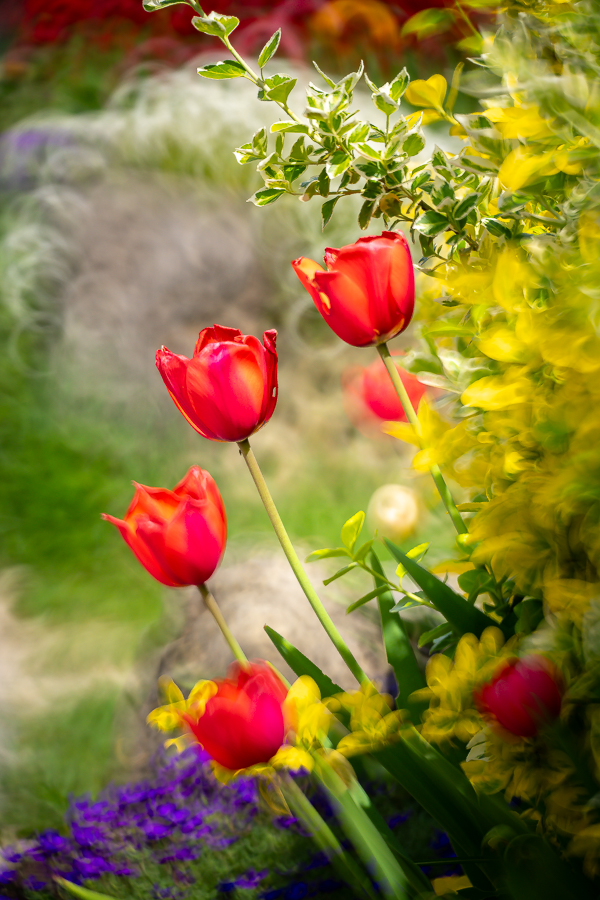
Nature and landscape images with lots of organic shapes and few linear structures
This is probably the lens’s most obvious application. Here, the bokeh really comes into its own, with an almost fairy-tale-like, baroque exuberance. Do you want this effect in every image? Of course not. But when it suits the subject and the mood, it creates an almost irresistible visual pull that few viewers can escape (in my subjective opinion, of course…).
This works particularly well with flowers, foliage and other organic shapes. Bare trees and branches, on the other hand, tend to produce the kind of rendering described in the next section, “Architecture and Technology.”



–







Architecture and technical stuff
The doubling of structures and edges mentioned above is definitely one of the lens’s weaknesses. I can hardly imagine anyone finding it aesthetically pleasing. It makes the background extremely busy and chaotic. It may be useful for very specific creative ideas, but in general, it is precisely the kind of effect one tries to avoid. As mentioned above, the same applies to some extent to landscape images featuring bare trees or other prominent edges and linear structures.


–
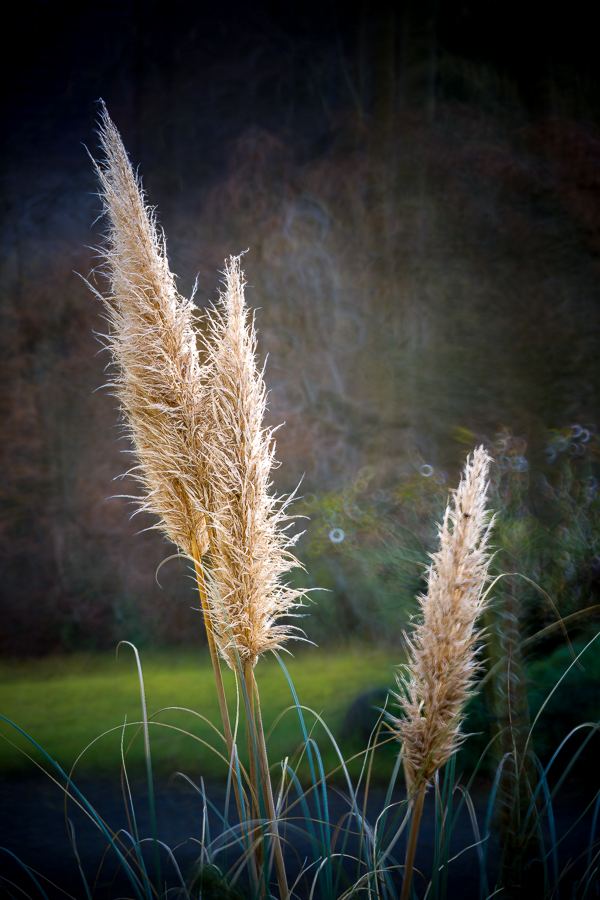
Diffuse light
In diffuse light, the Kase 5.6/200mm behaves most like a conventional lens. Under these conditions, landscape images are hardly distinguishable from those taken with a standard lens. Whether that is a good or a bad thing is for each photographer to decide. If you already own a lens with a similar focal length and bought the Kase primarily for its distinctive bokeh, you will probably be disappointed. Personally, though, I find it quite useful that the lens is also capable of producing “normal” images, since I otherwise don’t own anything with a comparable focal length.
–

–


Bokeh comparison
The same subject, photographed from the same position with different lenses, all cropped to the same framing. Each lens was tested at f/5.6 as well as at its maximum aperture (which, in the case of the Kase, is also f/5.6).
- Kase 5.6/200mm mirror lens
- TTArtisan 1.25/90mm
- Hasselblad XCD 3.4/75mm P

–

–

–

–

–
Conclusion
The Kase 5.6/200mm mirror lens has largely lived up to my expectations. I never saw it as an all-rounder, but rather as a lens with a distinctive rendering for specific occasions — similar to the TTArtisan 1.25/90mm. And that is exactly what Kase delivers with this lens. That is quite impressive, considering that Kase has so far been known primarily for its filters and that this is its first lens. You do, however, need to be aware of its limitations and use the lens accordingly. I had a lot of fun shooting with it, and I’m sure that autumn, in particular, will reveal plenty of suitable subjects for it.
For all photos in this blog: Copyright by Enrico Caccia, all rights reserved